Perspectives in Long Term Care
An original podcast series produced by the American Health Care Association and the National Center for Assisted Living, created specifically for leaders in the long term and post-acute care profession.
Listen on:







Episodes

Monday Mar 16, 2026
Monday Mar 16, 2026
In this episode, host Debbie Stadtler speaks with Nisha Hammel, Vice President of Reimbursement Policy and Population Health for AHCA/NCAL, about the rapid shift from fee-for-service to value-based care and what it means for long-term care and assisted living providers. Nisha reflects on her journey from geriatric social work to national policy leadership and explains how CMS has introduced roughly 11 new payment models in the past year. These models place increasing emphasis on prevention, provider accountability, technology-enabled care, and patient engagement, with more than 70 percent of payments now tied to quality and patient experience. The conversation explores several models that could affect providers, including the mandatory TEAM model, the state-based AHEAD and GEO AHEAD initiatives, and the forthcoming 10-year LEAD ACO model. Nisha encourages providers to stay informed, talk with clinical partners about ACO participation, understand their baseline utilization data, strengthen on-site clinical workflows to reduce avoidable transfers, and take advantage of AHCA/NCAL resources such as toolkits and the Population Health Management Summit.
Perspectives in Long Term Care is produced by Association Briefings.
Transcript
Debbie Stadtler: [00:00:00] The transition from fee-for-service to value-based care is here. Learn the latest on new CMS payment models in this episode of Perspectives in Long Term Care.
Hi, I'm Debbie Stadtler, editor-in-chief of Provider Magazine, the flagship publication of the American Healthcare Association and the National Center for Assisted Living.
I'd like to welcome you to this episode of Perspectives in Long Term Care, a monthly podcast produced by AHCA and NCAL. Each month we'll talk with long term care and assisted living professionals about the opportunities and challenges impacting the long term and post-acute care profession. My guest today is Nisha Hammel, vice president of reimbursement policy and population health for AHCA and NCAL.
She leads the association's policy and strategic initiatives on value-based care and innovative payment models. She brings 20 years of experience in post-acute care and senior living. Welcome, Nisha. Thanks for being with [00:01:00] us.
Nisha Hammel: Thanks, Debbie. Thank you for having me.
Debbie Stadtler: We'd like to start at the beginning, so tell us a little bit about you and your career journey.
What led you to get started in long term care?
Nisha Hammel: My career journey really began next door with my maternal grandparents who were like second parents to me. I grew up in a home and culture that really revered old adults, so my passion for aging was shaped early. You could say, I honestly never stood a chance of choosing anything else.
Even when my peers would ask like, what are you majoring in? I stuck with geriatric social work as my master's program back when only a couple of schools in the entire country offered it as even as an optional major. From there, I started out as a social worker in a skilled nursing facility and moved [00:02:00] through a variety of operational and leadership roles in assisted living, home health, hospice, affordable housing.
Really, I think each step taught me something new about caring for older adults with dignity. I really feel very blessed for that incredible journey. Eventually, I joined a state association where I helped lead providers in exploring new ways to work together that included some of our earliest conversations around value-based care and population health, and even how long term care could participate in Medicare Advantage in a meaningful way.
It was an experience I still consider a privilege, and it has carried me into essentially the next chapter of my journey, which led me to AHCA, where I now have the opportunity to help advance models and policies that [00:03:00] transform care for older adults and support the truly exceptional providers who care for them every single day.
Also, having the opportunity to advocate for some common sense policies to Medicare Advantage. I'd say each position has really felt like something I was called to do, and I am deeply humbled by this path and incredibly grateful that it all started with two grandparents right next door.
Debbie Stadtler: I'm always amazed at how many people have that personal connection, whether it's a grandparent or a family friend or a mother/father that really started them out in this profession.
And I think, like you said, so many people feel it's a calling. It's really such a personal connection to this work, and I think that makes it really special. I want us to talk about value-based payments. Set the stage for us. [00:04:00] Where are we now? What has happened recently? What's going on in this area?
Nisha Hammel: Sure.
I'd say value-based care has consistently received support from both Democratic and Republican administrations. While each may emphasize different elements, I think the overall commitment to achieving better quality and outcomes for every dollar spent has remained steady. What's happening now is that value-based care has accelerated pretty significantly in the last several years, and especially I think with this administration, it has been very highly active releasing or finalizing numerous models.
In the last year, going to this year, there's been about 11 models. Wow. Which, yes, which aligns with broader CMS movement to test, expand, or retire models, all with the [00:05:00] goal of improving outcomes and containing costs. So if we think about some of the pieces that may be slightly different in this administration, along with kind of let's say the cost-cutting, improving quality outcomes, patient experience, there's also been a strong shift towards prevention.
Also a greater focus on provider risk and accountability. So there's greater attention to having providers have some skin in the game. So not only upside, but also some downside risk. Technology enabled care is becoming much more central and there is a growing focus on the facts and benefits. Individuals are important partners in care.
And so the growing focus on patient engagement, you've seen that become much [00:06:00] more key in recent CMS models.
Sometimes there's a sense of Medicare Advantage and just thinking about Medicare Advantage and then pure fee-for-service. But if we think about what's happening today, you've really got more than 70% of payments that are now linked to patient experience and quality outcomes in some way. And that's, I think, an important statistic that's that we may not often think about.
Debbie Stadtler: I think that's a surprising statistic. I would not have guessed that it was that high, but it just clearly shows why the value-based care and the population health area is so important for providers right now. What do long term care and assisted living providers need to know? You mentioned 11 new models that have just come out within [00:07:00] the past year.
Do all the models apply to them? What do they need to know at this point in time?
Nisha Hammel: That's a great question. In the effort of CMS to redesign and look at things differently, there are certain models that apply more directly and there are models that are a little bit more adjacent, but helpful for long term care providers to track because.
The models, and I'd say the developments are important to monitor and understand because they could affect referral patterns. For example, care coordination expectations, and financial relationships.
Debbie Stadtler: Tell us more about the models that apply to long term care providers. I know there are several.
Nisha Hammel: So let's just start with the first model, which is TEAMs.
And TEAMs is a mandatory model. So the other thing you'll notice with this administration, they've launched a [00:08:00] few more mandatory models. So TEAMs is a mandatory episodic payment model that really holds hospitals in certain core based statistical areas accountable for the cost of care for an episode that essentially begins with the anchor hospitalization of the procedure.
And follows about 30 days post discharge for five. CMS considers high volume, high cost surgical conditions, and long term care providers and assisted living providers can often play a major role in patient recovery. And if you think about hospitals need strong post-acute care partners to help reduce readmission and ensure coordinated transition.
This makes facilities part of the ecosystem of this model. Like I said, important to note though the good news is that AHCA has a [00:09:00] toolkit and resources and data available for providers to understand. Does it impact me, first of all, am I one of those facilities there are in those CBSA, right? And then be able to look at data through Trend Tracker that enables them to understand scope, impact and be able to make more informed choices about the path that they may want to go down.
Debbie Stadtler: That's a good introduction to TEAMs. What's the next model we need to know more about?
Nisha Hammel: The second model that I'd like to call out is the AHEAD model, which is the achieving healthcare efficiency through accountable design.
And the uniqueness about this model is that it is a state level model. It was introduced under Biden administration and finalized by the Trump administration, and it is a voluntary state total cost of [00:10:00] care model, which started with Maryland. Starting this year in 2026 and is extended all the way to 2035, and you've got three different cohorts and participating states.
You've got Maryland, Connecticut, Hawaii, and Vermont as cohort two, and then Rhode Island and Downstate New York, certain downstate, New York counties, I should say in cohort three. And some of the kind of key features of these is that states can receive up to $12 million to build infrastructure to help design the program.
It includes hospital global budgets and like primary care, capitation, lag payments. So again, it's important to pay attention to the fact that it's certain states, but I think what is noteworthy in this is as part of [00:11:00] the states, CMS has also introduced Geo AHEAD, which is a AHEAD and a model, which essentially passively aligns any beneficiary that's not aligned to participating in another ACO program or Medicare advantage, or is in, for example, into the Geo AHEAD. And I think that's striking, and that's something different that I think providers participating in these regions need to be aware of because it will certainly automatically align these residents to ACO structures, and thus there could be corresponding care expectations.
Debbie Stadtler: So AHEAD applies only to certain states, and Geo AHEAD is different. Is there another model we need to know about?
Nisha Hammel: The next one that we'll go to is LEAD. And LEAD [00:12:00] is the long term enhanced ACO design. And I think providers should really pay attention to this one. It is a new 10 year accountable care model set to replace ACO REACH.
It's emphasizing stronger alignment, continues to focus on high need and complex populations, but it's also looking to engage providers that have not maybe previously participated in models, so safety net providers, rural providers. The model also includes CARA, which is CMS Administered Risk Arrangements, which essentially enables what's called like a shadow bundle pricing within ACOs, which may be an opportunity for long term care providers to collaborate in specialty and chronic care episodes.
This is on the short-term care side, for example. So [00:13:00] we do see broader participation opportunities for providers. We're expecting the RFA pretty soon, and so something for our providers to track something provided that AHCA is tracking very closely. And we have provided some recommendations to CMS in a recently released LTC focused ACO white paper that encourages CMS to recognize the value and the distinct population and setting, setting specific pieces that long term care providers bring and how they may think about engaging long term care providers. Slightly different in the LEAD model.
Debbie Stadtler: So LEAD focuses on high need and complex residents. What other models apply for long term care?
Nisha Hammel: Then a couple of other models I'll just call out, which I think is good to know about the ambulatory [00:14:00] specialty care model. It's a mandatory model targeting high volume, specialty conditions, starting with heart failure and low back pain, and the goal is to really improve outcomes and avoid or reduce avoidable hospitalization.
I know there's a ton of acronyms. But it would not be CMMI if it wasn't. All the acronyms are notable because it introduces prior authorization into fee-for-service for conditions that CMS notes are low value and at high risk for fraud, waste and abuse. One example being skin substitutes.
You've also got the ACCESS model, which promotes essentially tech enabled chronic care management. It's emphasizing the use of digital tools, remote monitoring, and AI driven support. I think what's interesting with this model is it's the first model that pays [00:15:00] for outcomes known as outcome aligned payments versus defined set of services or model parameters.
And then you've got MAHA ELEVATE, which is a model focused on chronic care and how lifestyle medicine can impact and moderate upstream drivers of health and like nonclinical supports and prevention. So I think a real opportunity for our assisted living providers to track and there've been, and then there are several other kind of drug pricing and pharmacy related models.
Debbie Stadtler: I think you make a really good point about how providers are not on their own with this. You mentioned that AHCA has toolkits, articles, things to help folks learn about all of these models, understand them, educate themselves. So while it seems like a lot of acronyms and a lot of new things coming out all [00:16:00] at once, and AHCA is really here to help folks get their hands around this and understand what they need to be doing or start doing.
Nisha Hammel: I think the beauty of the association and the fact that the association is supporting our members is that they have an objective resource. So if they're trying to figure this out, noodle it. There are a lot of partners and providers and vendors out there, and sometimes it may be difficult to sort through rhe noise or all the options, and I would encourage providers, that's what your association is here for and this is how we can support you.
Debbie Stadtler: Absolutely. What do providers need to know who are starting this value-based care journey? What do they need to know to prepare for this journey? What do you recommend as some of those beginning pieces?
Nisha Hammel: I [00:17:00] will probably sound like a broken record, but start by getting informed. Yes. If you don't already know about the models, explore it. Like we said, access some of the resources. Reach out. Attend AHCA’s Population Health Management Summit, which is the only conference of its type focused on long term care providers and assisted living providers meaningful participation in pop health. So I think this is, that's a fantastic, it's two days of the ability to get immersed, meet and network, meet some incredible folks that are doing some good things that have started that you've had some pioneers. So first of all, get informed. If you also don't already know, ask your physicians.
Ask the clinicians, your nurse practitioners for example, or physician's assistants that are coming into your building and seeing your residents. Whether they participate in an ACO or the value-based care arrangements. I talk to [00:18:00] providers around the country and they may assume that they're contracting with an independent provider, and until they ask the question, they aren't aware that the provider may, even if it's an independent prep provider, may be connected to an ACO.
And if they are, that means their beneficiaries are automatically part of that ACO. So get informed, ask questions. I would say understand your data. Know your baseline hospitalization rates, your emergency department utilization, your readmission rates. These metrics drive both quality and financial performance and value-based care.
Then get an understanding or essentially assess your clinical capabilities, right? Determine whether your clinicians have the competencies, the workflows needed to support proactive early intervention rather than defaulting to [00:19:00] hospital transfers, for example. And review policies and protocols. There are sometimes inadvertently policies and protocols can move people to hospitalizations or ED referrals, which may not be necessary, may not make sense.
Ensure you have structures in place that really empower teams to manage changes in condition on site whenever appropriate. It's so if something is unavoidable. You have to send a person out, but if it's avoidable, you want to make, be able to care for the person on side and then build, let's say internal alignment, engage leadership, nursing, medical staff early.
So the shift towards value-based care is deliberate and consistent with the organization's overall strategy and leadership and where you want to head and go.
Debbie Stadtler: We mentioned that [00:20:00] AHCA and NCAL provide resources, support, education on value-based care, but how else are they involved in this sort of transition to value-based care?
What is the association really advocating for in this space?
Nisha Hammel: Sure. AHCA is actively engaged and advocating on behalf of our members, and we are really advocating for value-based care models that reflect the true realities and the strengths of long term care settings rather than models designed for community-based populations.
We are urging policymakers to adopt frameworks, I referenced the LTC focused, ACO model, for example, that recognized nursing facilities and assisted living's really unique capabilities, including the 24-7 clinical oversight, the interdisciplinary care [00:21:00] teams, the onsite supports, the focus on social supports and the fact of food, three meals a day, plus snacks that provided transportation opportunities for active social engagement and the ability to manage these high need, high costs residents effectively.
So our global goal is to ensure, first that providers that want to be a risk-bearing entity have the opportunity to do that and have a pathway to do that. And for others that don't necessarily want to be the risk-bearing entity, but want to have meaningful ways to engage that reimbursement and regulatory structures can support them being able to effectively do so and support proactive timely care decisions made locally right in the settings where our residents live and where they call home. [00:22:00]
Debbie Stadtler: That makes a lot of sense. We really want to make sure that these models work well for AHCA and NCAL members, not the members having to squeeze themselves into models that are not quite set up for the specific populations and care that they give. So that makes a ton of sense.
So you mentioned a little bit earlier that this transition from fee-for-service, where you're really focused on services into being focused much more on outcomes is the hallmark of value-based care. How does this impact how we think about and measure quality? It really seems like it's almost a whole new idea on how we do that.
Nisha Hammel: The quality and outcomes is really at the heart of every value-based care model.
Debbie Stadtler: Yes.
Nisha Hammel: The challenge is that each model comes with its own set of quality measures. And those measures don't [00:23:00] always align well with the long term care population. Like I said, most of the models are designed for a community dwelling population, so that misalignment can create real barriers for nursing home and assisted living communities.
However, I'd say there are some core quality outcomes that are important no matter. Who the payer is, what the model is, and whether it's not directly a quality measure. What you do to drive towards that has impact? So for our older adult population, let's say three of the most meaningful indicators are reducing avoidable hospitalization, minimizing unnecessary emergency department visits, and reducing inappropriate readmission rates, right?
Because we know that when we keep our residents stable and cared for in place, that's better for their health. As a family member that's cared for a loved one, it [00:24:00] certainly makes a difference to my mental health and my kind of overall support, their experience and the overall system.
Debbie Stadtler: That makes sense.
Quality is obviously our North Star and to really be honing in on those quality measures that we know and we monitor and we keep tabs of every day: reducing the hospitalizations. That's what we know how to do. And so it's really great that this, even though it's a transition and some new things to learn, there's really still that focus on quality and we know what that looks like and how to do that well.
Nisha Hammel: That's exactly right.
Debbie Stadtler: What do you want listeners to take away from this? There's a lot to learn, a lot to know. What's your sort of bottom line takeaway right now?
Nisha Hammel: The most important takeaway is to be informed. Providers may ultimately decide [00:25:00] not to participate.
Absolutely. Their choice. It should be a conscious decision, not a surprise. I'd say while the growing number of models can truly feel daunting and having been a provider, it seems very overwhelming. It also presents an opportunity by offering maybe more pathways that weren't there previously to participate.
So there could be different points of entry and different ways to engage all not requiring providers to assume significant amount of risks, which understandably is not for everyone. We also know if we think about assisted living communities, there's a huge spectrum between providers that are more focused on the social model versus more of a health care model.
So really being very cognizant that many providers don't also [00:26:00] realize that their residents are already in ACOs. So where they are already helping manage, care and improve outcomes, they're just doing so without capturing the value that they're creating. And so stay informed, get educated, ask questions.
Utilize your resources. Please call me. Please call my colleague Rohini, and we are here to help.
Debbie Stadtler: I love that. Make sure you are informed and AHCA/NCAL is here to help you with that. I think that's just the greatest note to close on. Thank you again for joining us, Nisha. This has been a great discussion.
Nisha Hammel: Thank you so much, Debbie. Appreciate the opportunity.
Debbie Stadtler: Visit the AHCA/NCAL website or providermagazine.com to learn more about value-based care and payment models and the Population Health Management Summit. And thanks to everyone for [00:27:00] listening to this episode of Perspectives in Long Term Care. Join us each month as we discuss issues that impact the long term and post-acute care profession.
And be sure to subscribe to this podcast wherever you listen to your favorite podcasts. Take care.

Friday Feb 13, 2026
Friday Feb 13, 2026
In this episode, host Debbie Stadtler welcomes Heather TerHark, Chief Strategy Officer at Viva Senior Living, and Samantha Lawrence, Regional Vice President of Operations at Brightview Senior Living, for a conversation on redefining customer experience in long-term care. Together, they explore how organizations can move beyond traditional customer service to deliver more personalized, relationship-driven care. The discussion highlights the growing expectations of today’s residents, the impact of technology and AI on safety and engagement, and the critical role of staff training, empathy and culture in shaping meaningful experiences. The episode also invites listeners to get involved by joining the Customer Experience Committee to help advance resources and innovation across the industry.
Perspectives in Long Term Care is produced by Association Briefings.
Transcript
Debbie Stadtler: [00:00:00] Is your facility making the best impression possible on everyone who walks through the front door? Learn easy ways to boost your customer experience in this episode of Perspectives in Long Term Care.
Hi, I'm Debbie Stadtler, editor-in-chief of Provider Magazine, the flagship publication of the American Health care Association and the National Center for Assisted Living.
I'd like to welcome you to this episode of Perspectives in Long Term Care, a monthly podcast produced by AHCA and NCAL. Each month we'll talk with long-term care and assisted living professionals about the opportunities and challenges impacting the long-term and post-acute care profession. My guests today are Heather TerHark and Samantha Lawrence.
Heather is the chief strategy officer at Viva Senior Living and brings more than 27 years of experience to the table. Samantha is regional vice president of operations at Brightview Senior Living in New Jersey and has served seniors in various capacities for 26 [00:01:00] years. Heather and Samantha are the co-chairs of AHCA's Customer Experience Committee.
Welcome, Heather. Samantha. Thanks for being with us.
Heather TerHark: Thank you for having us, Debbie. We're so excited to be here.
Debbie Stadtler: We like to start at the beginning. So tell us a little bit about your personal journey, your career journey. How did you end up where you are now? What led you to get started in long-term care?
Samantha, start with your journey. Tell us a little bit about it.
Samantha Lawrence: So I was fortunate to know three great-grandparents and all of my grandparents and wow, when I was about 10 years old, my one great-grandfather had developed Alzheimer's. And at that time, communities like Heather and I had the opportunity to be engaged with didn't quite exist, so it was in a rural nursing home.
I went to visit my great-grandfather and a woman that was a patient/resident there grabbed my arm and said, honey, will you get me a laxative? I did not know what that was at the ripe old age of 10. But I knew she [00:02:00] needed something. So I went to the desk and I said, excuse me, this woman over there in blue, she needs a laxative and that nurse turned my career path.
Because she said, “Honey, she says that all the time. Just ignore her.” I didn't know what the right answer was, but I knew that didn't sound like the right answer. So I just went back and started talking to her and then you could not peel me out of there. I'm like, “Mom, this woman can't reach her cup. This woman is shaking and her food's falling off of her fork and we have to go.” Like I said, these people need help.
So volunteering closer to my home, playing the violin at dinner for a local nursing home, and they needed a part-time receptionist when I turned 16. I did a paper application. I called my mom on a payphone. I said I was really nervous about my big interview, and she said, “You are the only 16-year-old that is stoked about working in a nursing home. I think you'll get the job.”
And so then I never looked back. I grew my career in different frontline roles in reception activities, moved into management roles, got my administrator's license [00:03:00] in assisted living. Went into a subject matter expert role in dementia programming, but realized my heart was in operations, and been with Brightview now for the past 11 years, about six of those in a regional capacity, and was an executive director in Paramus, New Jersey, for them.
Opening that community actually prior to this role.
Debbie Stadtler: It's amazing how many people that I speak with that the beginning of their journey has some sort of family connection to how they start in this industry. So it's really interesting. Heather, tell us a little bit about your journey.
Heather TerHark: Sure I wasn't quite as soon as Sam at the age of 10, but a woman in college. We all think we're going into college and we have this career path all mapped at, and I was working at a hospital as just more of that part-time job that you do in college and I got the opportunity to work with physicians, walking seniors on the track, some of them doing [00:04:00] stress testing. I got to teach water aerobics to seniors, and that was the start in college of my entire career because I knew right then and there, those were the people and I learned so much from a medical component being in the hospital going through surveys. So I got started right off at the age of 18. And I've been so blessed in my career to work post-acute rehab, skilled nursing, the entire senior living continuum, and also home health, hospice and pharmacy through just a few companies throughout my career, and my mother and my grandmother also passed away with Alzheimer's dementia.
So memory care communities have a very, very special place in my heart, and I'm so excited both Sam and I have the opportunity to have either memory care communities or memory care neighborhoods [00:05:00] and know that we do things to enhance the lives of those that live. And so it's a personal journey. I tell people I don't know what it's like to work outside of the health care field because I've never done anything that wasn't part of the world that we all live in today.
Debbie Stadtler: It's amazing that passion and that connection with people with seniors is really just so evident in everyone who works in the industry. So I love how your journey really highlights that as well, Heather. I want to jump into our topic today, which is customer experience, which is a little bit different. I think a lot of people are used to hearing the term customer service, which I think is a little piece of it.
But start us off and get us all on the same page. What is customer experience and what is that encompass so that we know what that term really refers to? Heather, start us off.
Heather TerHark: Sure. So customer experience is everyone that comes into contact [00:06:00] with your community. It doesn't matter who it is, it could be a potential resident, a family member, a potential employee, but it also could be a fireman that comes in when there's 9-1-1 call. It could be the postman, the UPS that drops off. That is the experience because they're all our customers, because whether they're looking to work or to live in our community, they're part of that ecosystem that makes up that community and they form an impression and they have a feeling about that community of how the vibrancy or in the involvement or the heartbeat of that community. So truly that customer experience talks about anyone that interacts or has any kind of touchpoint with what we do.
Debbie Stadtler: I think it's such a broad amount of people. I understand what you're saying, that it's really anyone who comes [00:07:00] into contact and has an experience with your organization, your facility, but that's a lot of different groups, potential residents, families, current residents. Those are all different groups with different needs. How do you serve each of those groups? How do you make sure this experience is consistent or excellent across all of these folks? Samantha, tell us more.
Samantha Lawrence: So the joy and the challenge of serving so many different customers, that the experience is unique to every single person.
Everybody comes to us with different emotions about being in that community or that facility. You've got prospective residents and families that are very apprehensive. This could symbolize to them a loss of independence. It could symbolize a big change. They live in the same home for 60 years. For that, maybe somebody that's a vendor or if the fireman, maybe this is their first day on the job, maybe they've never been to a community like ours before.
There's a combination of personalized and generic things that we all [00:08:00] need to do to make sure that we're giving a great customer experience when individuals come through our doors. When it comes to residents in particular and that kind of thought of. It's scary to transition into communal living after so many years just pretty much doing your own thing, really getting to know them as individuals from the prospect to moving in. We try to ask so many questions to get at the heart of their current situation, if they're a prospect or once they move into our doors. What is it that brought them joy, brought them purpose in the real world, quote unquote, because this is their real world as well.
It's just going to feel maybe a little bit different, but how can we as an organization, focus on the possibilities, independence and choices that they still have, and really focus on those possibilities rather than the limitations they may be feeling? So it's really knowing them all as individuals as much as we can, and infusing resident centered hospitality along the way as much as we can throughout that experience.
Heather TerHark: Debbie, if I could add to [00:09:00] Sam's comment that when she talks about the hospitality, it's the really small details. How were they greeted the minute when they walked into the community? How were they greeted on the phone? Is there water out? Is there coffee? Is there someone saying, let me get someone for you? How do folks in the atmosphere feel when you walk through the community?
But the details are really important because you don't know. As you said earlier, who your customer is, so you have to embrace 'em and make them feel like this is just a great place to be, even if they're the postman who's dropping off the mail for the day.
Would you like some coffee? Can I help you somehow? All those things you're talked about, you and taught about with hospitality. [00:10:00] So I want to make sure that to everyone who's listening, it doesn't cost money, but it does take training. It does take time with the staff to really make sure that they know the ways to greet and welcome.
Debbie Stadtler: Speaking of staff, I think that is a big question because if your customer is everyone you're coming into contact with, then you know, making this excellent impression isn't just the responsibility of the front desk or the intake person who's meeting the potential residents. This is everyone on staff.
It's all the staff, it's the volunteers, it's the management. So how do you determine the skills or the roles that you're infusing into staff to support this customer experience? How do you teach or train some of this?
Samantha Lawrence: It starts, as you just said so beautifully, with [00:11:00] our associates. And at our organization, we firmly believe at the very foundation, if we're not as a company creating a great place for our associates to work, there's no way that they can in turn create a great place for our residents to live or all of those other vendors to walk through the door.
So it starts at the kind of lower level Maslow's hierarchy of making sure that as an organization we are thoughtfully caring for our associates. Making sure we have meaningful benefits and meaningful appreciation for everything that they do, so that they feel great about what they do when they come in the door.
And then when it comes to the skillset, before they even get to us, we're doing behavioral-based interviewing. We can teach them how to answer a phone or what they should say, or how they can take an order at the dining room table. But I can't teach them to have heart and passion for what they do.
So we start out with a group interview process that tries to get at the heart of some of these customer experience or service types of questions to get a [00:12:00] feel for if there's an innateness in them in that regard. And if we can start there, then we can interview to the scale on a one-on-one basis and move on from there.
And really make sure we actually have developed specific hospitality training to make sure that some of the things that Heather mentioned about answering a phone, eye contact. Making sure that if you don't know the answer, you don't end it there. You go and get somebody for you. And actually one of the things our committee did this past year for our members is develop some customer experience training with different scenarios that could pop up in different departments so that people have a resource to utilize for a quick hit in dining, in maintenance, and care with common situations that come up.
And I think that was a great deliverable last year. That can just be a small touch if folks might not have some of those resources independently.
Heather TerHark: And I would just add exactly what Sam said. When someone walks in for an interview, whether it's an individual hiring manager or it's a group, if they [00:13:00] have passion, if they have heart, if they are there for the right reason and then you can train the rest of it.
Yes, they may have to have their med tech or their LPN license or certain things. But you can have two people with the exact same resume and the exact same certification or degrees. But it's how they respond. Do you watch them before the interview sitting in the lobby? Do they interact with the residents?
When you take them on a tour to the community, how does that potential associate employee, how do they interact with the residents? How do they talk to them when the residents talk to them? Because those are the folks that we want in our industry, because you can have a job description. But it doesn't really always encompass no job description.
Say you have to turn the remote on for the resident. No job. [00:14:00] Best description says we, how many times are we going to look for the eyeglasses and the dentures kind of things that we do without thinking, because that's what's important to that resident that lives there and all the much more complicated things that they've made with the TVs and all of that.
Now, who's going to do those extra little things when you talk to them?
Debbie Stadtler: Absolutely. You can definitely sense that sort of connection and heart. I think that's really a great way of putting it, of someone who wants to be of service and hospitable to folks. Sam, you mentioned scenario-based training as one way to help folks develop these skills.
Tell us a little more about different types of training or different ways that facilities can help their staff be a little more open to this type of customer service and experience.
Samantha Lawrence: Sure. I think that one of the hardest things when you try to train to hospitality is it [00:15:00] often makes people feel they have to say yes to everything, and that's not necessarily a great thing either.
So, it's important to communicate that a “yes mentality” is important. But as a team, we all need to set expectations of what is reasonable to expect and what's not reasonable to expect. And if somebody has something that they would like to do or there's always that one-off transportation request, I think we can all empathize with, or that one-off extra time with care or a dining request or something that we unfortunately just can't accommodate that day.
So how do we say no without saying no? It's just as important as saying yes. Just saying, “You know what? While that's not something that's possible, I'd like to offer you this alternative, or maybe we can do this instead.” So just really having that yes mindset, but knowing that it might not always mean saying yes, and it's about offering some alternatives based on the expectations that we've all set forth from the beginning in a consistent way.
Also, we talked [00:16:00] earlier about focusing on relationship-building with our residents and knowing their preferences, but also understanding that knowing those preferences is not, does not mean making assumptions. For example, if Mrs. Jones always loves her orange juice every single morning. While some might think, oh look, they have the orange juice preset, maybe today she feels like cranberry juice. But how do you show that you still know her and know her preferences and respect them, but give choice. You walk up and say, “Mrs. Jones, is it an orange juice kind of morning, or are we feeling like something different today?” Because maybe she'll say, “You know what? I'm tired of orange juice.” And maybe she's too polite to say no. And so there's a way you can confuse the world of choice, but also showing that our residents well, and it's just really continuing to focus on all of your interactions are based in that foundational relationship because if there's trust that you are able to build through that relationship development.
Customer experience just gets that much easier. It all starts with relationships and trust. [00:17:00]
Heather TerHark: I absolutely agree. The other thing I would add is teaching our associates, our employees, that they have the ability to problem solve, that they have vision. To solve a problem that it doesn't have to go to a department head or the nursing home administrator or the executive director that they've been caught.
These are things you can solve that are simple types of things, because a lot of times it can just be taken care of right there at that moment. To Sam's example of the transportation, you know, “Debbie, we cannot catch you up for transportation this afternoon. What does tomorrow morning look like for you? I see we already have some openings for that.”
Instead of saying, oh, no, I'm sorry, and just leaving it there. How can we train them to take the next step? How can we also train them to actively listen? It's something that all of us, no matter where we're at in our [00:18:00] profession, we think, “Oh, we're in a hurry. We're really going to move fast”. How do we make them take a breath and to see that this resident needs something and how do we help them? And sometimes that's so much harder than that sounds because there's another call light going off. Or they know that this resident, they're supposed to be in their room at this time to give them a shower and really, okay, let me repeat.
Now, Debbie, is that what you said to me that you need, let me figure out how we do this. Let's go look for what's missing, whatever the case may be. And then just truly teaching them some emotional intelligence if they say something's wrong, not to take it personally. There's a lot that goes into what a family member says.
That's because of guilt. It has nothing to do. But we sometimes take it personally because we have pride, we have passion, and we're doing the best we can. We're working as hard. How many times have we had to [00:19:00] teach them don't take anything personally, but we're here to solve that. We're here to create that best customer experience without worrying about what the issue is, how it reflects on anyone.
And sometimes teaching them that empathy doesn't mean to Sam's point that we're going to solve all of the problems, because some of it we can't solve what they're emotionally going through.
Debbie Stadtler: I think those are such big pieces that you guys mentioned. Trust, relationship building, empathy, listening.
Not to solve necessarily, but really to hear a person out in a lot of situations. Those are such important skills in work like this where it's so human-focused and so person centered to be able to bring those types of skills.
We all know that long-term care has changed so much over the past five years, 10 years, 20 years, and [00:20:00] with the baby boomers and the silver tsunami, there are expectations.
How have the expectations around customer experience changed? What are some of the things that baby boomers are really focused on and look for as they have these experiences with our communities? Heather, what do you think?
Heather TerHark: Oh my gosh, Debbie. It has changed so, so much. Just as our worlds have changed with Amazon and Uber and Netflix and all their expectations changed.
They're used to right-on-demand delivery. They're used to personalization. They are used to that responsiveness and. Going back to where we talked about earlier, hospitality, and whether it's post-acute rehab or it's senior living, they expect almost a lifestyle to it. Yes, they [00:21:00] need medical care, but they expect more than just good medical care now.
They expect so much more and it's going to just continue to shift and evolve even more. And so how do we step up as organizations to serve today's customer is really, I think, a conversation that continues because the expectations aren't going to get less.
Samantha Lawrence: That's a really great point, and I think when you think about just our industry, and Heather and I have been in it for about the same amount of time.
The nursing home residents that I started with back in the day is today's assisted living resident. And today's assisted living resident is the independent living resident. People are coming to us, often at a later phase of their journey, but they're still expecting that lifestyle that Heather described and we've created as a society, a very on-demand culture.
So going back to that transportation example earlier, they're [00:22:00] used to going on their phone maybe and having themselves or their adult child or somebody help them get an Uber instantly or order. A meal on DoorDash or delivery with food, or I want to watch this TV show right now. I can turn on Netflix or what if they can’t work the remote?
I'll get there. And so it's how do we find ways to anticipate needs so that we can try to get ahead of some of those demands or requests or desires or needs at the end of the day? I think one of the questions we get a lot is how are you evolving as a business? What are new tools, processes, services, programs?
People want to know that you're thinking ahead and sometimes aren't even always interested in what you're doing today. They want to know where you're going with some of the offerings because the consumers at all ages are very well educated now about what it is that we do, and they very much want to continue their existing independent lifestyle [00:23:00] within our communities.
Debbie Stadtler: I think that idea of evolution is so interesting and so much of what has changed in the world in general revolves around technology and the strides that it's made. So you know, what is the role of technology in this customer experience, hospitality service world. And how do you balance it with the things that are so human with that empathy and relationship building and things like that?
What's the balance between the technology and the human touch? Samantha, tell us more.
Samantha Lawrence: Sure. I think one of the big things I know that we've done, going back to the pandemic, really leveraging some of the very basic tools that we have FaceTiming and not stopping FaceTiming at, okay, the pandemic's over, everybody's out.
But if there is somebody that needs some assistance with connecting with a loved one, there's a way that I've built that relationship with that resident helped me FaceTime my loved one, and that's a great [00:24:00] customer service, customer experience piece. But it's also a way to leverage a very basic piece of technology on a broader scale.
One of the things I'm really excited about is fall prevention or technology. I know our organization is in the process of rolling out safely you and our dementia care neighborhoods, and it's a fall detection software that detects fall motion and sends that alert immediately to our team. And our team is able to respond more quickly.
What's been the greatest gift of this software is not only does it prevent an unnecessary hospitalization because we didn't see what happened in a different scenario, and we might send someone out of an abundance of caution. It's detected injuries that we might not have known happened because the resident got themselves back into bed before we got there quickly.
But it's also been a great associate training tool because as we watched the video recording back of what happened, we are able to see body language and did we illustrate empathy in the way that we physically reacted to the [00:25:00] resident? And it's created great training tools, not necessarily that we even had to train to, but an associate watch it and says, “Oh my gosh, I would've gotten down at eye level next time I do that. I look like I was standing over that person.”
And so it's a great way to illustrate the strengths that we have, as well as the opportunity areas we might have. So it's a great way to leverage technology to help us, but not in a way that eliminates the human touch and actually really enhances the human touch.
Debbie Stadtler: I think that's a great point. Enhancing is really a keyword there, Heather, is that what you're seeing?
Heather TerHark: Absolutely. And not only technology-enhancing, but I think that the technology, as Sam said, what are we doing as an organization next year in five years? AI is gonna play a big part in this too, as they scrub records, as they summarize things for us and [00:26:00] what we're so used to, okay, is it HIPAA compliant? Is making sure there's no security breaches? But the resident wants to know the highest wifi fastest speeds. How do we merge all of that together with the on demand, the great technology, not just fall detection, but also being able to know if they're restless at night, and what if they have had an accident from moisture being detected?
What ways for them to have more freedom, even if they do wander from a memory care standpoint and not feel like they just have small places to wait. All those things that technology helps us do to better care and provide a better customer experience. But how do we blend it all together as an organization from a security standpoint, from a cost standpoint.
Also, let's face it, [00:27:00] teaching staff how to use some of it only as good as what you use it or that you provide. The data comes from that technology. So it's a small shift that I think isn't going to stop right now.
Because how many have walked into different buildings and we're like, we have great wifi, but then there's pockets that we still have to find in the buildings.
Buildings are big, so we haven't fully even got wifi where we want, in a lot of cases. What do our new policies and procedures look like when you start talking about fall detection or you start talking about families putting cameras in to monitor? What does this all mean to us? But we have to find a way to do it because that's what the customers expect.
And there's a ton of things I think all of us are working on, but I think this is just the very, very beginning and I really [00:28:00] believe AI is going to play a big part in it too.
Debbie Stadtler: There's so much possibility. It's really amazing and a lot to try to integrate. Like you said, you really want everything integrated and working and all of that good data flowing and things like that.
So that's a really great point of not only using the technology, but making sure we're really executing well with it. This has been a great conversation. I have learned so many things about ways to enhance my experience with other people and have a better customer experience, so I appreciate your information and wisdom with us today.
Heather and Samantha, thank you so much for joining us.
Samantha Lawrence: Thank you for having us. We had a great time.
Heather TerHark: Yes, thank you. This, it's been great to speak to everyone at AHCA-NCAL and we always are looking for members for our customer experience committee in the next year.
So please know we would love to have you be part and help [00:29:00] us expand the customer experience journey and we're working to just try resources for members. As Sam mentioned earlier, with different scripts and playbooks and things of that nature.
Samantha Lawrence: Absolutely.
Debbie Stadtler: Thanks to everyone for listening to this episode of Perspectives in Long Term Care. Join us each month as we discuss issues that impact the long-term and post-acute care profession and be sure to subscribe to this podcast wherever you listen to your favorite podcasts.
Take care.

Monday Jan 12, 2026
Monday Jan 12, 2026
In this episode, host Debbie Stadtler sits down with David Gifford, MD, MPH, chief medical officer of the American Health Care Association, for a thoughtful conversation on building trust in long-term care. Dr. Gifford shares his career journey and explores why trust is foundational to effective healthcare systems. Together, they discuss the role of empathy, authenticity, and clear communication in strengthening relationships among care teams, residents, and families. Dr. Gifford also addresses the challenges technology can introduce and offers practical strategies for cultivating trusted colleagues and leading with intention. The episode includes actionable guidance for fostering stronger trust and communication in long-term care settings.
Perspectives in Long Term Care is produced by Association Briefings.

Wednesday Dec 10, 2025
Wednesday Dec 10, 2025
In this episode, host Debbie Stadtler sits down with Clif Porter II, CEO of the American Health Care Association and National Center for Assisted Living, to reflect on his first year in this dual leadership role. Porter shares key accomplishments from the past year—including meaningful progress on Medicaid reform and staffing mandates—while emphasizing the importance of staying connected to the “why” behind their mission and recognizing the diversity and purpose-driven nature of long-term care careers. Looking ahead to 2026, Porter discusses top priorities such as strengthening regulatory environments, addressing challenges with Medicare Advantage plans, and supporting a resilient workforce. He also underscores the critical role members play in shaping policy, calling for deeper engagement with Congress and continued advocacy for the sector.
Perspectives in Long Term Care is produced by Association Briefings.

Wednesday Nov 12, 2025
Wednesday Nov 12, 2025
In this episode, host Debbie Stadtler talks with Mark Gogal, vice president of workforce development at the North Carolina Health Care Facilities Association. Their conversation focuses on the essential people management skills every leader needs—self-awareness, empathy, and active listening—and how these qualities shape effective servant leadership. They also explore strategies for recruitment and retention, the value of a welcoming workplace culture, and the ways technology and AI are transforming the long-term care landscape. Mark emphasizes the ongoing responsibility of leaders to grow, adapt, and create environments that support both their teams and the residents they serve.
Perspectives in Long Term Care is produced by Association Briefings.

Monday Oct 13, 2025
Monday Oct 13, 2025
In this episode, host Debbie Stadtler sits down with Nate Schema, president and CEO of Good Samaritan, to explore the challenges and opportunities shaping the financial sustainability of long-term care. From his early days as an administrator-in-training to leading the nation’s largest nonprofit senior care provider, Nate shares lessons learned about leveraging scale, investing in the workforce, and embracing technology to enhance quality and stability. The conversation also highlights the power of servant leadership and the role of strategic partnerships in delivering lasting value for residents, staff, and communities.
This episode is sponsored by Pharmerica.
Perspectives in Long Term Care is produced by Association Briefings.

Friday Sep 05, 2025
Friday Sep 05, 2025
In this episode, host Debbie Stadtler celebrates National Assisted Living Week with Scott Yaeger, regional director of operations at Chelsea Senior Living. Scott reflects on his journey from intern to regional director, the company’s beginnings, and its focus on building strong connections with both employees and residents. Listeners will also hear from Chelsea resident Mo Resner—a lifelong Cubs fan, former player and coach, and comedian—who shares colorful stories from his career, including the thrill of throwing a first pitch at a Cubs game and his many adventures with the team.
This episode is sponsored by Pharmerica.
Perspectives in Long Term Care is produced by Association Briefings.

Wednesday Aug 13, 2025
Wednesday Aug 13, 2025
In this episode, host Debbie Stadtler chats with Avi Olitzky, president and principal consultant at Olitzky Consulting Group, about navigating conflict in the workplace. Avi unpacks the essential role of tools, trust, and structure in fostering productive conversations and psychological safety. He shares practical skills—like active listening, empathy, humility, and emotional regulation—alongside proven frameworks. The conversation also examines how leaders can model the behaviors they want to see, creating a culture that supports open dialogue and resolution.
This episode is sponsored by Jubo Health Technologies.
Perspectives in Long Term Care is produced by Association Briefings.

Monday Jul 14, 2025
Monday Jul 14, 2025
In this episode, host Debbie Stadtler sits down with Mark Klyczek, FACHE, president and CEO of Virginia Health Services, to explore how apprenticeships are helping solve healthcare’s workforce challenges. Mark shares highlights from his career and explains how structured, supportive apprenticeship programs are creating meaningful career paths, boosting retention, and attracting diverse talent—including military families. He also offers real-world success stories and actionable advice for healthcare organizations looking to launch their own programs.
Perspectives in Long Term Care is produced by Association Briefings.
Tuesday Jun 10, 2025
Tuesday Jun 10, 2025
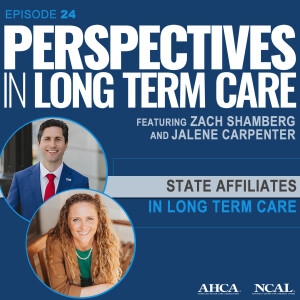
In this episode, host Debbie Stadtler is joined by Jalene Carpenter, president and CEO of the Nebraska Healthcare Association, and Zach Shamberg, president and CEO of the Pennsylvania Healthcare Association, about the pressing challenges and emerging opportunities in long-term care. Jalene shares Nebraska’s innovative approaches to workforce development, including licensing reform, hybrid training models, and early engagement strategies. Zach discusses Pennsylvania’s legislative efforts to improve reimbursement structures and tackle staffing shortages. Together, they explore the importance of collaboration at the state and national levels, the role of immigration policy, and what’s ahead for long-term care reform.
Perspectives in Long Term Care is produced by Association Briefings.
Meet Your Host
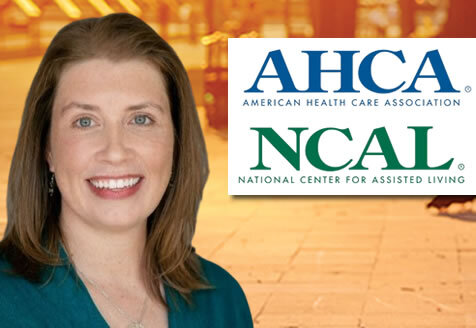
Debbie Stadtler is the editor in chief of Provider Magazine, the flagship publication of the American Health Care Association (AHCA) and National Center for Assisted Living (NCAL). In addition to managing the print magazine, she also facilitates website content, videos, email newsletters, and more. Prior to AHCA/NCAL, Stadtler was the managing editor of the quarterly journal for the Society of Human Resource Management, and she is a Certified Association Executive. In her spare time, she likes to spend time with her husband, three boys, and dog, along with reading, traveling, and drinking coffee.